Case Study • Machine Learning
A machine learning pipeline that distributes high-level pharmaceutical sales targets to individual pharmacies, transforming a manual distribution task into an auditable, data-driven process.
Distributors know their monthly product targets at a high level. Field teams need them per pharmacy, and they need numbers that reflect each outlet's real capacity and track record instead of one-size-fits-all guesses.
The data is hard: most pharmacy-product-month combinations are zero. A standard regression smears demand everywhere and looks fine on average while being useless on the ground.
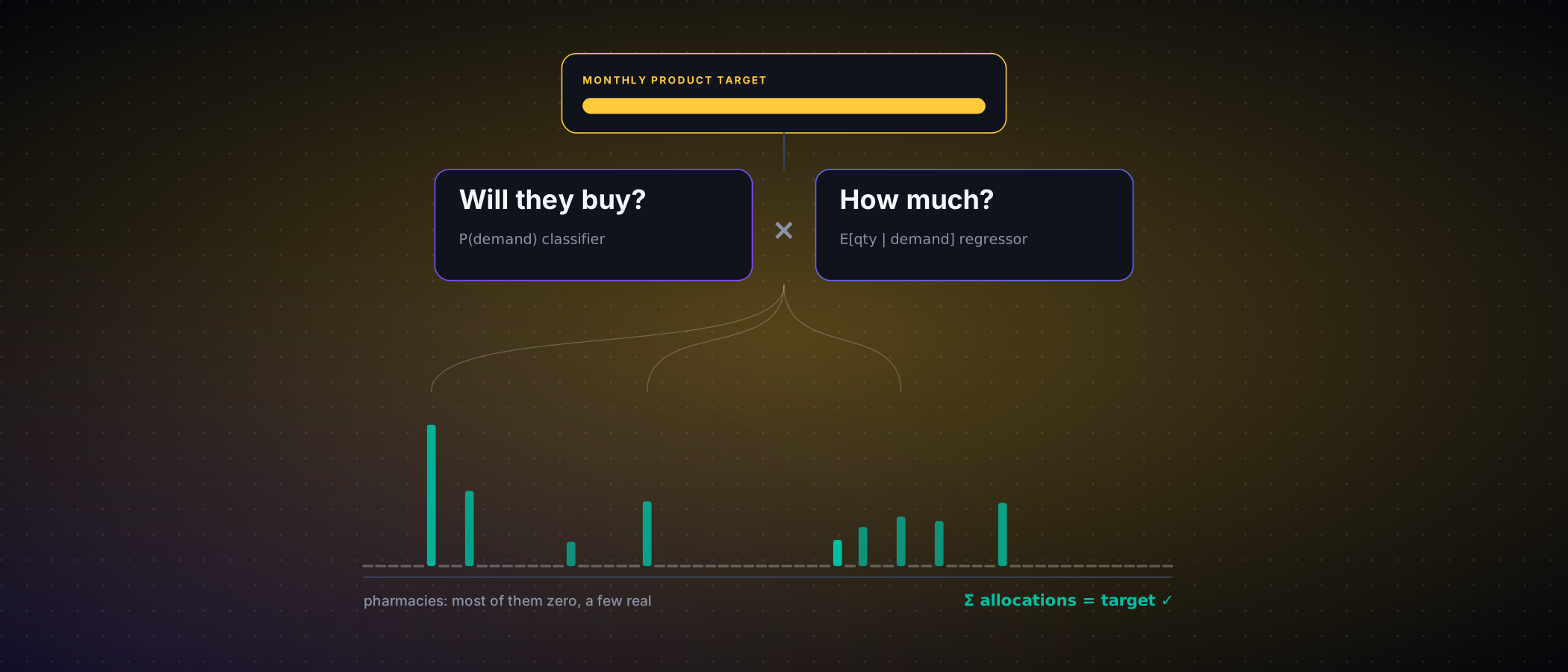
When most of your data is zero, "will they buy?" and "how much?" are two different questions.
Model the two questions separately, then force the answer to respect the totals.
A classifier estimates the chance of real demand for each pharmacy, product and month.
A conditional regressor sizes the demand, given that it happens at all.
Proportional reconciliation and largest-remainder rounding make allocations sum to the target.
From raw sales history to integer allocations a field team can use.
Predictions are reconciled against strict monthly product constraints with near-perfect precision.
Success is reported across all rows and across positive allocations, so sparsity can't flatter the result.
Every allocation traces back to a model output and a policy, instead of a spreadsheet nobody can explain.
